What is ASQ-3?
The Ages & Stages Questionnaires, Third Edition (ASQ-3) is a parent-completed screening tool that gives a snapshot of a child's development across five domains. It indicates whether further evaluation is needed.
How did the screening go?
A few quick questions after a screening. Your answers help improve the program.
Five Developmental Domains
Age Intervals
Each questionnaire covers a specific age window. Select an age group to see the exact age range for each interval.
A red star (*) marks the universal screening ages: 9, 18 and 30 months and whenever parents and doctors have a concern.
Why Screening Matters
The ASQ-3 takes parents 10 to 15 minutes to complete, and it turns their everyday observations of their child into a clear starting point for a more informed conversation with you.
The early years are the most active period for building the brain's neural connections, more than a million new connections form every second in the first years of life.1 Yet in Kuwait, a child's average age at referral to a developmental pediatrician is 3.5 years (Sabah Hospital data), well after that critical early window.
Routine screening supports earlier identification, which leads to earlier intervention and better outcomes for the child.
1. Harvard University, Center on the Developing Child, "Brain Architecture."
Running a screening, step by step
Practical tips and reminders for running a screening, scoring it, and reading the result.
Selecting the Form
Each ASQ-3 questionnaire covers a set age window, printed at the top of its first page (for example, "15 months 0 days through 16 months 30 days"). Choose the questionnaire whose window includes the child's age.
If a child was born 3 or more weeks early, adjust their age until they turn 2. Subtract the number of weeks premature from the chronological age, then use the adjusted age to choose the form.
Introduce the ASQ-3 to Parents
It's a quick check of strengths and areas that may need support. It is not a test, and not a diagnosis.
Have parents try each activity first, make it a game, and screen when the child is rested and fed.
Their answers guide the conversation and whether further assessment is needed.
Scoring
Parents answer every item with one of three responses. Add the points within each of the five domains to get a domain score, then compare each domain score to that questionnaire's cutoff on the ASQ-3 Information Summary sheet.
Six items per domain × 10 points = a maximum domain score of 60. Compare that total to the cutoff for the interval you used. Cutoffs differ from questionnaire to questionnaire.
Blank Items
When a parent leaves a blank item, first try to get an answer.
A blank often means "no opportunity yet," not "can't do it."
Many items can be drawn out on the spot with the child.
Keep the item's intent the same and get at the underlying skill, in everyday terms the parent recognises.
Scoring of Omitted Items
Leave an item blank only if it truly can't be answered or isn't appropriate. Then, if needed, adjust the score:
Still score the domain: average the answered items and add that average back in for each blank item.
Don't score that domain. Follow up with the parent to fill in the missing answers first.
A parent leaves 1 item blank in Fine Motor. The 5 answered items score 10, 10, 5, 10, 0, giving a total of 35. The average of the answered items is 35 ÷ 5 = 7. Add 7 back in for the blank item, and the adjusted domain score is 42.
Reading Results
Each domain total lands in one of three zones on the score sheet. The chart shows where an example child's scores fall. Cutoffs shown are illustrative, for one questionnaire interval.
"Results in this domain show your child's [domain] development is on schedule."
"This is the monitoring zone. You can do activities together to give your child more chances to practice [skill], and we'll check back in ___ weeks to see how they're doing."
"This is the referral zone. It may help to check in with a specialist about how best to support your child's [domain] development. I can make a referral to ______."
Overall Section
Beyond the five domains, parents answer a set of general yes/no questions, each with room to explain. These questions are not scored, but any concern a parent raises should always be followed up with a conversation and, where appropriate, a referral.
Referral Best Practice
Referral policy and destinations by health region. Open the full-size PDF to zoom in or print.
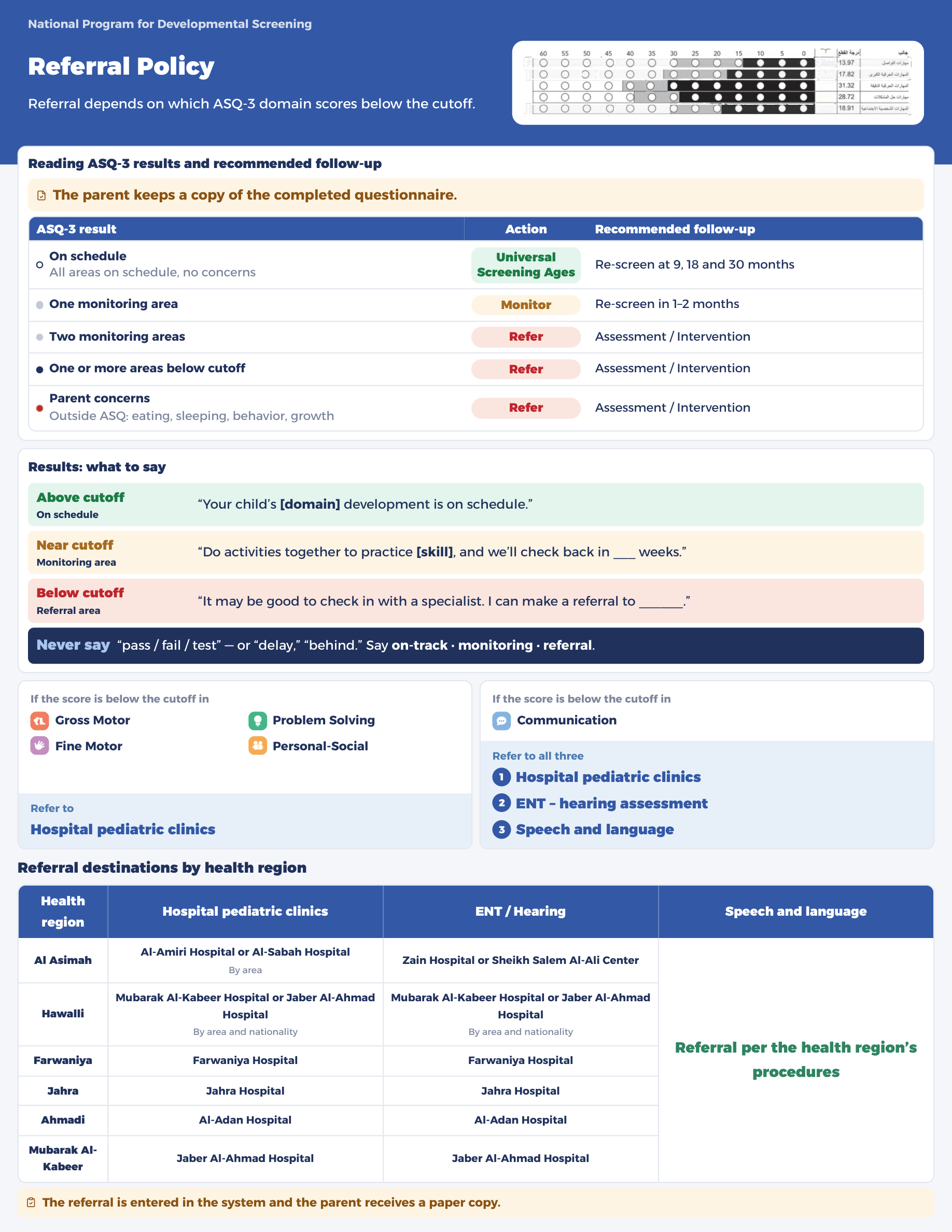
Always refer to assessment and intervention together, regardless of the child's age.
Loading training registration…
Print & Request Forms
Request ASQ-3 Form
Enter your name, center, and phone number so we can contact you about your request.
Print ASQ-3 forms
Enter the access password and type your center's name to continue.
The ASQ-3 license is purchased per center, and every center prints from its own license.
Select the forms to print
Choose one or more age intervals. Open and print each selected Arabic questionnaire from the next screen.
Contact us
Questions about training or resources? Call or email us directly.